Thousands of years ago, Neolithic painted pottery culture from the middle and upper reaches of the Yellow River traveled westward along the Hexi Corridor — in today's Gansu province — before spreading across the northern and southern foothills of the Tianshan Mountains in what is now the Xinjiang Uygur autonomous region. Here, it blended with local traditions and continued radiating further west.Artifacts demonstrating this remarkable journey are on display in an exhibition that opened on April 10 at the Xinjiang Museum.
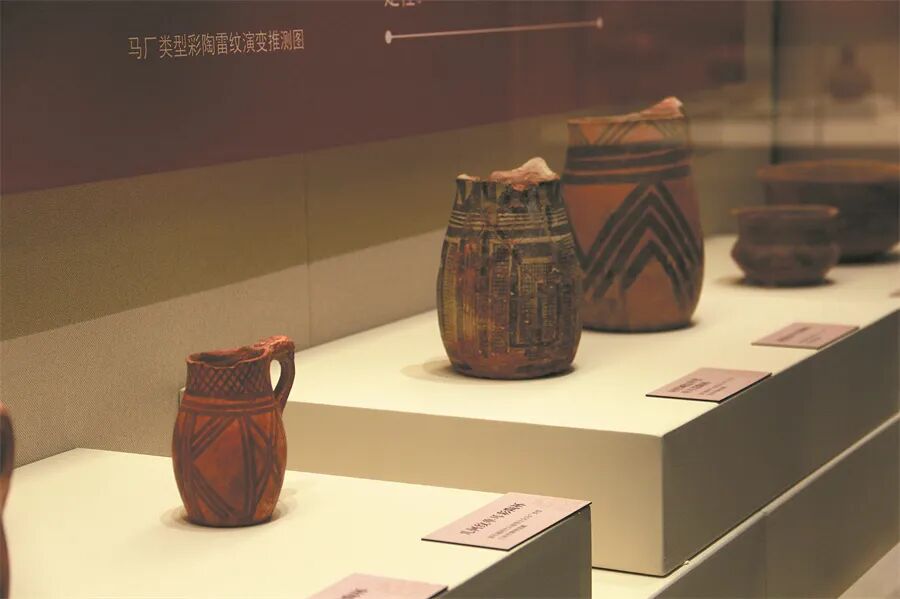
Pottery items demonstrating the westward spread of prehistoric craftsmanship from the Yellow River Basin to today's Xinjiang Uygur autonomous region are on show.Photo provided by Fang Aiqing/China DailyThe exhibition, From the Yellow River Basin to Tianshan Mountains: Tracing the Westward Journey of Prehistoric Painted Pottery, features 175 sets of pottery from the collections of the Gansu Provincial Museum, Xinjiang Museum, and 13 other cultural heritage institutions across the two provincial-level regions. The exhibition, running through July 10, was previously displayed at the Gansu museum.
Against ocher and reddish-brown surfaces, ancient craftspeople expressed extraordinary creativity.
Delicate geometric grids, flowing spirals, fish motifs, petals and abstract deity patterns reveal a striking command of line and form. Elegantly curved vessels and animal-shaped decorations, including eagle and goat heads, further testify to the imagination and skill of prehistoric artisans.
Based on years of archaeological findings, the exhibition traces the spread of painted pottery craftsmanship across thousands of kilometers from east to west over more than 3,000 years.
Wang Nannan, director of the exhibition department at the Gansu Provincial Museum and one of the exhibition's curators, says Gansu and Xinjiang are geographically linked and share deep cultural roots, exemplified by the westward expansion of painted pottery culture, which carried early people's aesthetic ideals and passion for life.
Both Xinjiang and Gansu have a significant east-west expanse: Xinjiang stretches nearly 2,000 kilometers and Gansu about 1,500 km.
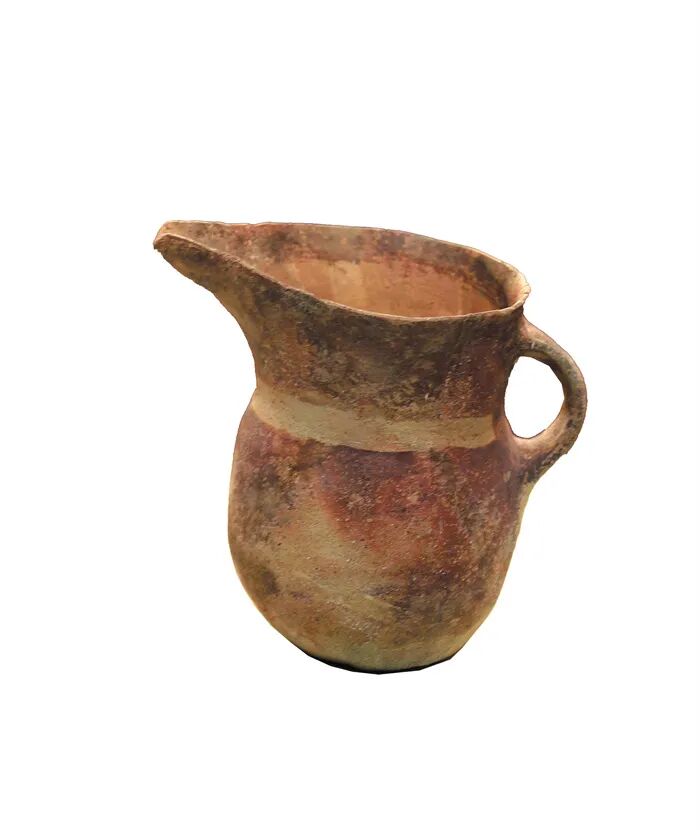
A pottery jar (left) from the Siba culture, in Gansu province, and a Bronze Age pottery jar unearthed in Xinjiang are among the objects on display. Photo provided by Fang Aiqing/China DailyThe upper reaches of the Yellow River flow some 900 km in eastern Gansu. To the west, the long and narrow Hexi Corridor — "Hexi" means "west of the Yellow River" in Chinese — has served, since ancient times, as a key route linking the Central Plains with the country's western regions and beyond.
Wang notes that the prehistoric routes of painted pottery transmission through the Hexi Corridor largely overlapped with the ancient Silk Road, as both relied on the same geographical artery.
Building on this geographical and archaeological reality, scholars have named the east-to-west expansion of early Chinese culture — represented by painted pottery — the "Painted Pottery Road".
Han Jianye, professor at the School of History, Renmin University of China, has studied this topic for years and published a collection of essays on it.
According to Han, painted pottery from present-day Shaanxi and Gansu provinces spread westward from the 4th to the 1st millennium BC. Divided by the Qinghai-Tibet Plateau, the routes branched into a northern path — spreading to Central Asia and beyond via Xinjiang -and a southern path toward the Kashmir region.
"The Painted Pottery Road was the primary channel for early cultural exchanges between China and the West and can be regarded as a precursor to the Silk Road," he writes.
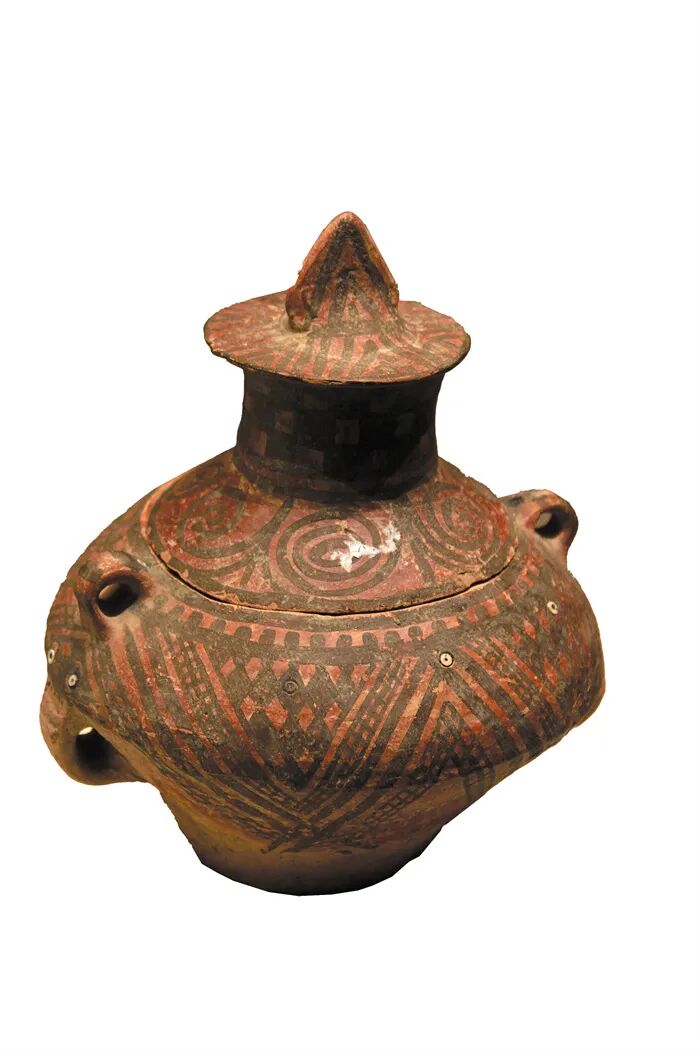
A pottery jar (left) from the Siba culture, in Gansu province, and a Bronze Age pottery jar unearthed in Xinjiang are among the objects on display. Photo provided by Fang Aiqing/China DailyThe ongoing pottery exhibition highlights the evolution of painted patterns and vessel shapes, offering a visual thread for understanding this westward transmission.
The middle and upper reaches of the Yellow River were among the birthplaces of prehistoric painted pottery. At the Dadiwan archaeological site in Qin'an county, eastern Gansu, archaeologists have unearthed pottery dating back around 8,000 years. These vessels are typically round-bottomed, or tripod bowls decorated with red bands around the rim, with pigments usually applied before firing. They are among the earliest decorated pottery discovered in China.
Between 7,000 and 5,000 years ago, the Yangshao culture flourished in the Central Plains. Its pottery featured black-painted patterns of straight lines, geometric shapes, fish, petals, and leaves. Around 5,500 years ago, its iconic petal patterns — seen on Miaodigou-type pottery of the mid-Yangshao period- had already spread across much of present-day Gansu and eastern Qinghai provinces.
In eastern Gansu, Yangshao traditions evolved into the Majiayao culture, which thrived some 5,300 to 4,000 years ago. During this period, painted pottery reached an artistic peak.
On display at the exhibition are pieces featuring exquisitely intricate patterns such as lozenges, spirals, gourd-shaped grids, birds and deities, which cover the entire vessels.
During the late Majiayao period, painted pottery — along with the agricultural culture that produced and used it — kept advancing into multiple regions.
The branch that extended toward the Hexi Corridor developed into the Siba culture. Dating back around 3,900 to 3,400 years, it marked the transition from the Neolithic period to the Bronze Age. Its western reach stretched to the Hami Basin in eastern Xinjiang, where it interacted with the local Tianshanbeilu culture.
Double-handled jars unearthed from the Tianshanbeilu cemetery site feature hanging straps and large grid patterns similar to those found in Siba culture pottery. Square spirals and fret motifs seen on late Majiayao and Siba wares also appear in Iron Age relics discovered in Hami.
Around 3,000 years ago, painted pottery flourished in central Xinjiang cultures, including Subeixi in the Turpan Basin and Chawuhu, mainly distributed in the Bayingolin Mongolian autonomous prefecture. Artifacts from these areas provide evidence of eastern influences and local adaptation.
The small-mouthed, bulging-bellied design of Subeixi single-handled jars retained the influence of the Yellow River Basin. At the Chawuhu ancient tomb complex, pottery with red paint on a light background featured a bottom design better suited for hanging and carrying, reflecting the needs of nomadic life.
In Xinjiang, many vessels were found with a liu (spout) for easy and smooth pouring.
Wang notes that compared with Yangshao and Majiayao pottery, Xinjiang's prehistoric ceramics featured simpler decorative patterns but more practical functions.
"As painted pottery spread westward, the vessels became smaller but more practical," he says, adding that this change reflected adaptation and integration — evidence of the strong inclusiveness of Chinese civilization.
He explains that the exhibition is organized around geographical nodes, allowing visitors to easily trace the deep connections between ancient communities in Xinjiang and the Central Plains. For example, visitors can observe striking similarities between two single-handled vessels — one from a late Majiayao site in Gansu and another from Bronze Age remains in Xinjiang.
The late Majiayao piece is barrel-shaped, with the handle attached near the top. Its upper part outlines triangular layouts with bold lines, set apart by three horizontal lines, while the lower part features vertical zigzag patterns.
The Xinjiang artifact, on the other hand, has triangular patterns above horizontal dividing lines and circular spirals below; its body is rounder, and the handle is positioned at the center of one side.
"Sometimes it's hard to describe the similarities in words, but when placed side by side, one can naturally feel the resemblance," Wang says.
He adds that the exhibition presents a complete and tangible chain of cultural transmission that requires little specialist knowledge to appreciate.
It is believed that painted pottery began to decline in Xinjiang around the Warring States Period (475-221 BC), with patterns becoming increasingly cursory. This art form survived in the region for nearly 2,000 years before almost disappearing after the Western Han Dynasty (206 BC-AD 24).
Li Zheng, director of the Xinjiang Museum's exhibition department and another curator of the exhibition, says the emergence, spread, and development of painted pottery fully demonstrate Xinjiang's important role in the cultural development of Chinese civilization.
"Although these artifacts were scattered across a vast expanse along the Painted Pottery Road, they shared similar aesthetics and craftsmanship," Li says.
"The routes connected the Yellow River Basin and the Tianshan Mountains in a millennia-long dialogue, vividly illustrating how Chinese civilization is diverse yet unified, continuous, and enduring," he adds.
The exhibition will travel to Bayingolin and later to Hami.
Reporter: Fang Aiqing and Mao Weihua
Marbuya Abdureyim contributed to this story.
本文来自公众微信号:CHINADAILY
|
|

 /1
/1 


 鄂公网安备42010202000179号 )