北外视频:
英音版录音
(点击右边三个点,可调整速度,电脑上可下载)
美音版录音
(点击右边三个点,可调整速度,电脑上可下载)
新一各课单词和课文分句朗读录音目录
Lesson 43 Hurry up!快点!
Listen to the tape then answer this question. How do you know Sam doesn't make the tea very often?
听录音,然后回答问题。你怎么知道萨姆不常沏茶?
PENNY:Can you make the tea, Sam?
SAM:Yes, of course I can, Penny. | 1 |

| SAM:Is there any water in this kettle?
PENNY:Yes, there is. | 2 |

| SAM:Where's the tea?
PENNY:It's over there,
behind the teapot. | 3 |

| PENNY:Can you see it?
SAM:I can see the teapot,
but I can't see the tea. | 4 |

| PENNY:There it is!
It's in front of you!
SAM:Ah yes, I can see it now. | 5 |

| SAM:Where are the cups?
PENNY:There are some in the cupboard. | 6 |

| PENNY:Can you find them?
SAM:Yes. Here they are. | 7 |

| PENNY:Hurry up, Sam!
The kettle's boiling! | 8 |

|
New words and expressions 生词和短语
| of course /əv-'kɔ:s/ 当然 | now /nau/ adv. 现在,此刻 | | kettle /'ketl/ n. 水壶 | find /ffaind/v. 找到 | | behind /bi'haind/prep.在……后面 | boil/'bɔil/v. 沸腾,开 | | teapot/'ti:pt/n. 茶壶 | |
Notes on the text 课文注释
1 make the tea, 沏茶。
2 over there 是指“在那边”,指比较远的地方。
3 在 There are some in the cupboard中,some是代词,指some cups。
4 hurry up, 赶快,在祈使语气中用来催促他人。
参考译文
彭妮:你会沏茶吗,萨姆?
萨姆:会的,我当然会,彭妮。
萨姆:这水壶里有水吗?
彭妮:有水。
萨姆:茶叶在哪儿?
彭妮:就在那儿,茶壶后面。
彭妮:你看见了吗?
萨姆:茶壶我看见了,但茶叶没看到。
彭妮:那不是么!就在你眼前。
萨姆:噢,是啊,我现在看到了。
萨姆:茶杯在哪儿呢?
彭妮:碗橱里有几只。
彭妮:你找得到吗?
萨姆:找得到。就在这儿呢。
彭妮:快,萨姆。水开了!

【语法知识】
情态动词can的用法
①can't“能,会”,常用表示“能力”或“客观可能性”,还可以表示“请求”和“允许”。它的否定式是can't或者cannot。例如:
Can you finish this work tonight?你今晚能完成这项工作吗?
Man cannot live without air.没有空气,人类不能存活。
Can I go now?我可以走了吗?Yes,you can.可以。
②could也可以表示请求,语气更加委婉,主要用于疑问句,不可用于肯定句,答语应用can(即could不能用于现在时态的简略答语中。)例如:
Could I come to see you tomorrow?明天我可以去看你吗?
Yes,you can。是的,可以的。
③can表示能力时,还可以用be able to代替的。例如:
I'll not be able to come this afternoon.我今天下午来不了。
【裕兴笔记】
[课文讲解]
1. can 表示能够,会
疑问句把情态动词can提前。
--Yes, of course I can, Penny.
--of course
--certainly
--surely
--Yes, certainly I can.
--Yes, surely I can.
2. Is there any water is this kettle?
--water 水(不可数名词)
--there is
--some water 一些水
--疑问句—any water
3. Where is the tea?
Tea 是不可数名词,我们要用is.
4. It’s over there, behind the teapot.
--over there 较远的那边
--behind the teapot 在茶壶的后面(进一步解释over there)
--behind------in front of 在….的前面
5. Can you see it? -can表示“能够” see 看见(结果)
--I can…, but a can’t…
我能够….但我不能…
but是连词,表示转折。
I can ride a bicycle, but I can’t drive.
I can wash the dishes, but I can’t wash the clothes.
6. There it is. 倒装句 Here it is .
7. There are some in the cupboard. 在碗橱里有几只。
--some在此处是代词,代替the cups, 因此系动词要用are.
--some 作代词的例子还有:
--some of the students 学生当中的一些
8. hurry up 赶快(在祈使语气中用来催促别人)
9. The kettle’s boiling=The water in the kettle is boiling.
[小结]:
情态动词can表示“能够、会、可以”,后面加动词原形,没有人称和数格的变化。在疑问句和否定句中,can 本身起变化。
情态动词虽然具有实际意义,介却不能单独作谓语,必须与后边的动词一起作谓语;无人称数的变化;在疑问否定中,情态动词本身起变化。
--there is 跟可数名语单数、不可数名词 --there are 跟可数名词复数形式
--one/some/ones
--one 单数可数名词
--some 不可数名词、可数名词复数
--ones 可数名词复数

Lesson 44Are there any…?有些……吗?
Is there any…?有些……吗?
Listen to the tape and answer the questions
听录音并回答问题。
(点击右边三个点,可调整速度,电脑上可下载)
seventy

bread on the table | eighty

hammers behind that box | ninety

milk in front of the door | a hundred

soap on the cupboard | two hundred

newspapers behind that vase | three hundred

water in those glasses | four hundred

tea in those cups | five hundred

cups in front of that kettle | six hundred

chocolate behind that book | seven hundred
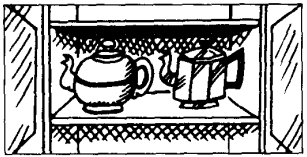
teapots in the cupboard | eight hundred

cars in front of that building | nie hundred
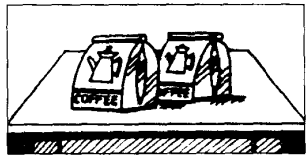
coffee on the table |
Written exercises 书面练习
A Look at these:
注意名词的单数和复数形式:
glass—glasses; book—books; housewife—housewives.
Rewrite these sentences.
改写以下句子,用名词的复数形式填空。
Example:
I can see some cups. But I can't see any______(glass).
I can see some cups, but I can't see any glasses.
1 I can see some spoons, but I can't see any______(knife).
2 I can see some hammers, but I can't see any______(box).
3 I can see some coffee, but I can't see any______(loaf) of bread.
4 I can see some cupboards, but I can't see any______(shelf).
5 I can see Mr. Jones and Mr. Brown, but I can't see their______(wife).
6 I can see some cups, but I can't see any______(dish).
7 I can see some cars, but I can't see any______(bus).
B Write questions and answers using these words.
模仿例句提问并回答。
Examples:
bread/on the table
Is there any bread here?
Yes, there is. There's some on the table.
hammers/behind that box
Are there any hammers here?
Yes, there are. There are some on the table.
1 milk/in front of the door
2 soap/on the cupboard
3 newspapers/behind that vase
4 water/in those glasses
5 tea/in those cups
6 cups/in front of that kettle
7 chocolate/behind that book
8 teapots/in that cup board
9 cars/in front of that building
10 coffee/on the table
|
|


 /1
/1