A 300-megawatt solar project in Chamdo, Xizang autonomous region, has deployed high-altitude-adapted installation robots during construction, underscoring the growing role of intelligent technologies in overcoming extreme conditions and advancing renewable energy development on the plateau.
The project, in Yechen township of Pashoi county at elevations above 4,300 meters, faces challenges that include low oxygen levels, harsh weather and a construction window of less than five months each year.
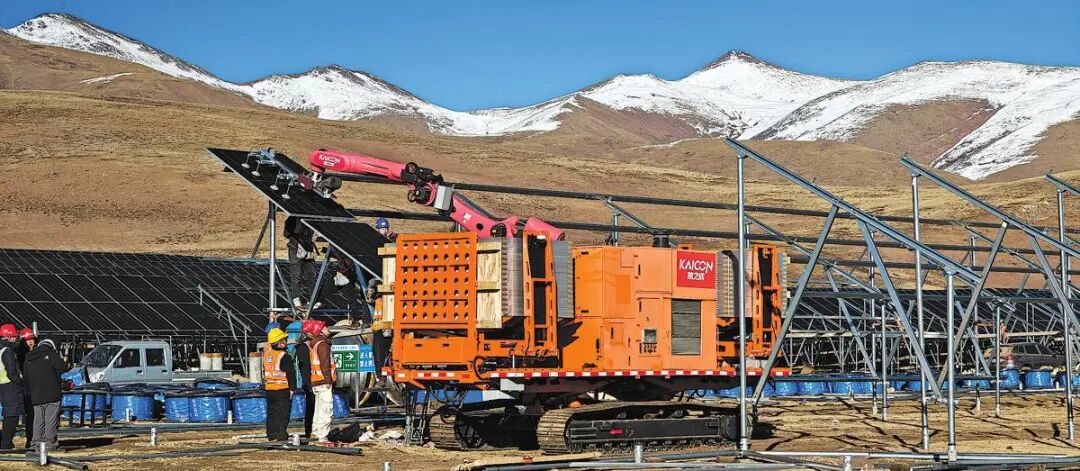
An intelligent robot installs solar panels at a photovoltaic project site in Yechen township, Chamdo, Xizang autonomous region. CHINA DAILYDeveloped by Datang Yuquhe Hydropower Development Co, the project is a key component of eastern Xizang's clean energy base. Construction began in August.
"Traditional construction methods are difficult to sustain under such conditions," said Yang Shuanglong, the project manager. "Introducing intelligent equipment is both a practical solution and an important step toward upgrading construction methods in high-altitude areas."
To address these challenges, the project introduced four high-altitude-adapted photovoltaic installation robots as part of a pilot program exploring scalable solutions for plateau solar construction.
Operating under a "remote control plus on-site support" model and supported by a 5G system, the robots are capable of autonomous navigation, precise positioning and integrated panel installation, Yang said.
Each robot can install up to 100 solar panels per hour, with daily output exceeding 600 panels — about twice the efficiency of manual labor. Equipped with a high-precision 3D vision system, the machines maintain millimeter-level accuracy under strong ultraviolet radiation, while a hydraulic leveling system enables operation on slopes of up to 12 degrees.
"The robots significantly improve efficiency while reducing safety risks for workers," he said.
At such altitudes, manual installation requires workers to carry components weighing up to 39 kilograms, placing physical strain on laborers in oxygen-thin conditions. The robots have taken on high-intensity tasks such as lifting and positioning panels, reducing the risk of fatigue and injury.
Yang said early results from the pilot program show the technology is well suited to high-altitude environments and could be expanded in future projects across Xizang.
The deployment of robotic systems reflects a broader shift from labor-intensive construction to technology-driven solutions in extreme environments, with potential applications in other large-scale renewable energy projects, he said.
Once fully operational, the project is expected to generate about 530 million kilowatt-hours of electricity annually, enough to meet the needs of around 1.38 million people. It will also help reduce carbon emissions and support Xizang's transition toward a cleaner energy mix, Yang said.
The Yechen project, with a total investment of 980 million yuan ($143.5 million) and planned land use of about 357.6 hectares, has also generated economic benefits for surrounding communities.
It has contributed nearly 15 million yuan in income through housing rentals, equipment leasing, transportation and catering services, according to local media reports. More than 100 residents from nearby villages have been employed on-site, earning a combined total of more than 300,000 yuan.
Local residents have seen new income opportunities emerge alongside the project.
"We have taken up temporary construction work in addition to traditional herding, earning about 260 yuan per day," Dawa Gyaltsan, a resident from Yamda village, said in a Xizang Daily report.
Before construction began, residents in Yamda and Ochung villages mainly relied on livestock grazing and occasional temporary jobs to earn a living.
The project also includes ecological protection measures to minimize environmental impact in the fragile alpine ecosystem, including soil conservation and vegetation restoration during construction.
It has also incorporated a "solar-grazing" design model, with solar panel structures elevated to allow livestock to graze beneath them without disrupting traditional pastoral activities, according to the project team.
Reporter: Daqiong and Zheng Jinran
本文来自公众微信号:CHINADAILY
|
|

 /1
/1 


 鄂公网安备42010202000179号 )