The Bangkok International Motor Show, which ended in early April, saw Chinese electric vehicle manufacturers dominating booking orders. Chinese brands, led by BYD, secured a remarkable seven of the top 10 spots.
According to an analysis by energy think tank Ember, ASEAN countries now have some of the highest EV sales penetration rates in the world. Fueling this transition is the deepening cooperation between China and ASEAN in the green economy.
Chinese EV companies are not just entering the Southeast Asian market, but are also helping build local industrial ecosystems to support ASEAN's green transition.

Visitors look at an electric car at the 47th Bangkok International Motor Show 2026 in Nonthaburi, Bangkok, Thailand, on March 28. ANUSAK LAOWILAS/GETTY IMAGESSAIC-GM-Wuling Automobile Co, for example, holds over 37 percent of Indonesia's EV market share, according to Xiao Qiang, the company's overseas business department general manager.
"Indonesia is also Wuling's first overseas base with a full industry chain. Its local plant, operational since 2017, has an annual capacity of 120,000 vehicles, partners with 60 local suppliers, and has trained over 300 local professionals," said Xiao.
With the launch of its latest battery production line last year, Wuling has introduced its core EV technologies — battery, motor, and electronic control — into Indonesia, catalyzing an upgrade of the local automotive supply chain, Xiao added.
The signing of the China-ASEAN Free Trade Area (CAFTA) 3.0 Upgrade Protocol last year has further cemented green economic cooperation. For the first time, the protocol provides clear definitions for key concepts related to the green economy and commits to not using environmental standards as a guise for trade protectionism.
Experts believe the rising importance of green collaboration between China and ASEAN is driven by shared development goals, complementary strengths, and external challenges.
Chen Zhihua, associate professor at the Belt and Road School of Beijing Normal University, pointed to the strong complementary advantages in resources, technology, and industry between China and ASEAN.
With a population exceeding 690 million, ASEAN's accelerating urbanization and industrialization are creating a massive demand for electricity and a pressing need for clean energy technologies and green infrastructure, he said.
"Chinese companies possess the engineering and financing capabilities to undertake large-scale energy projects, helping to bridge the infrastructure and investment gap ASEAN faces," Chen said.
"The cooperation between China and ASEAN is not a one-way street of aid or export but a mutually dependent partnership. China needs ASEAN's markets, resources, and manufacturing bases to extend its green industrial chain, while ASEAN needs China's technology, capital, and engineering capabilities to achieve energy transition. This deep structural complementarity gives the cooperation intrinsic momentum and sustainability."
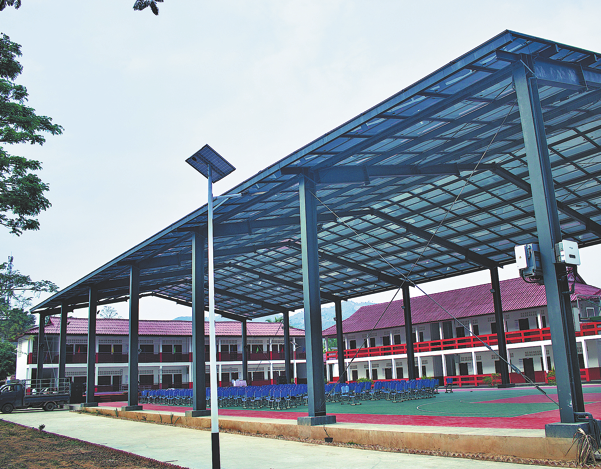
The roof of a high school basketball court in Oudomxay Province, Laos, is made of photovoltaic glass produced in China. XINHUAChristine Susanna Tjhin, director of strategic communication and research at Indonesia's Gentala Institute, highlighted shared climate vulnerabilities and shared climate and development goals as key drivers of green economic cooperation.
"Both ASEAN members and China are committed to global climate targets and to deepening regional integration through ASEAN-based mechanisms that support mutually beneficial, inclusive, and equitable development."
Yang Fang, associate professor at the School of International Relations of Xiamen University, echoed this view, stating that previous achievements in China-ASEAN green cooperation have laid a solid foundation for its emergence as a new hot spot.
"Whether it's Chinese-funded clean energy projects or the emergence of various collaboration models like green industrial parks, they fully demonstrate the solid foundation and strong market demand for green cooperation," she said.
Data from the International Renewable Energy Agency shows that China and ASEAN have become major contributors to global renewable energy capacity additions. Their combined new capacity increased from 57 percent of global renewable energy additions in 2020 to 65 percent in 2024.
Lawrence Loh, director of the Centre for Governance and Sustainability at the National University of Singapore Business School, said that the green economy, as a new focal point of China-ASEAN cooperation, creates a win-win synergy in crucial economic domains, particularly trade and investments, creating job opportunities for the domestic settings of ASEAN that benefit local livelihoods.
Beyond bilateral benefits, experts also highlighted the significance of China-ASEAN green cooperation for the global green transition, calling it a powerful force for improving global climate governance.
Yang emphasized the important contribution of China-ASEAN green cooperation on a global scale.
"In 2024, China and ASEAN together account for over 20 percent of global GDP and about 36 percent of global carbon emissions. By jointly promoting low-carbon transition, China and ASEAN will profoundly change the global energy structure and emission patterns.
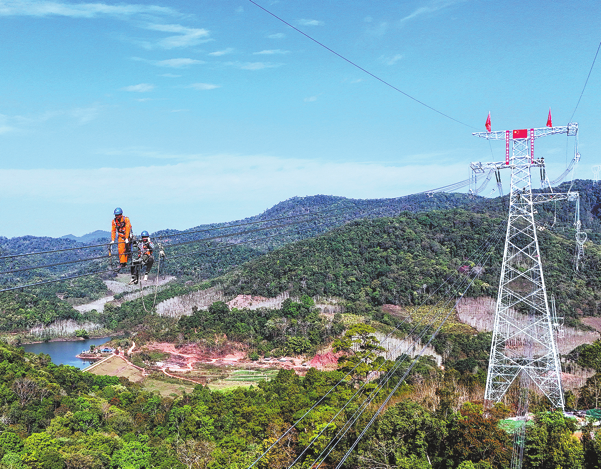
Workers check wires of the China-Laos 500 kilovolt cross-border interconnection project in Yunnan province, on Feb 5. XINHUALowering costs
"Through cooperation with ASEAN, the accelerated promotion of Chinese clean energy technologies leads to continuous price declines due to scale effects, making clean energy more affordable globally and effectively lowering the threshold for global green transition," she said.
"This path of lowering costs through cooperation to drive mass adoption is a unique advantage of developing countries in driving the global energy transition."
Tjhin, from Indonesia's Gentala Institute, said the emphasis and arrangements for green economic cooperation in CAFTA 3.0 serve as a strategic counterweight to the pressures of unilateralism in global climate governance.
"CAFTA 3.0 provides a more constructive contrast. Its green economy program is not about punishment or protectionism; it is about building capacity and mutual benefit. Aside from the reaffirmation of WTO principles, CAFTA 3.0 can build a constructive model for South-South cooperation that rejects unilateral coercion and encourages equitable collaboration toward green transition," she emphasized.
Chen said the recent uncertainty in US climate policy poses significant risks to global climate governance, while the green cooperation framework established by China and ASEAN at the regional level actually plays a stabilizing role in the global climate governance system.
"For a long time, the global climate governance framework has been primarily designed by developed countries, with developing countries often being passive rule-takers. CAFTA 3.0 — led by a group of developing countries — has achieved regional mutual recognition of green standards for the first time," he highlighted.
"Unlike the Western 'carbon tax + technology monopoly' approach, the China-ASEAN green cooperation model shows that through means of sharing technology, jointly building industry capacity, and aligning standards, a low-carbon shift can be achieved without sacrificing growth," Chen said. "Global South countries can indeed navigate a 'development and transition' green path through mutually beneficial cooperation."
Reporter: Yang Ran and Shi Ruipeng
Agencies contributed to this story.
本文来自公众微信号:CHINADAILY
|
|

 /1
/1 


 鄂公网安备42010202000179号 )