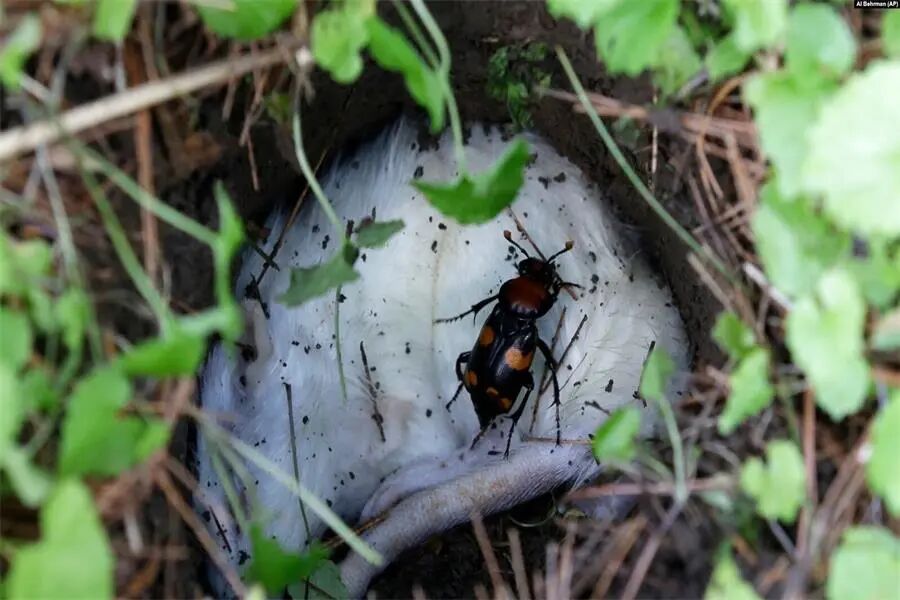
Like all good parents, some beetles go to great lengths, or do a lot, for their offspring.
就像所有优秀的父母一样,有些甲虫会为它们的后代竭尽全力。
To humans, though, some of this beetle behavior can be surprising or even gross.
然而,对人类来说,这种甲虫的一些行为可能令人惊讶,甚至恶心。
To feed their future offspring, beetles look for dead animals, like mice or birds.
为了喂养它们未来的后代,甲虫会寻找死去的动物,比如老鼠或鸟类。
But before burying the animals for safe keeping,
但为了安全起见,在埋葬动物之前,
the insects clean the skin and roll the body into a ball.
甲虫会清洗动物的皮肤,并把动物身体卷成一个球。
Then they cover the body in a thick liquid sometimes called goop.
然后用一种有时被称为粘稠的液体覆盖尸体。
(Technically it is called "gut secretions.")
(严格来说,它被称为“肠道分泌物”。)
Scientists used to think this goop was only used to slow the decaying process.
科学家们过去认为这种黏液只是用来减缓腐烂过程的。
Now, however, they think it does more than that.
然而现在,他们认为它的作用不止于此。
It might also hide the smell of the decaying body and create another smell that tricks other competitors in search of food.
它也可能隐藏腐烂尸体的气味,并制造出另一种气味来欺骗其他寻找食物的竞争者。
The leader of the research, Stephen Trumbo, said this goop "helps them to hide their resource from others.
该研究的负责人斯蒂芬·特朗博表示,这种液体“帮助他们在他人面前隐藏自己的资源。
They try to keep everyone away."
他们试图让所有人都远离他们。”
Trumbo studies animal behavior at the University of Connecticut.
特朗博在康涅狄格大学研究动物行为。
The findings were recently published in a study appearing in The American Naturalist.
这些发现最近发表在《美国博物学家》杂志上的一项研究中。
Not surprisingly, these beetles are called burying beetles.
不出所料,这些甲虫被称为埋葬甲虫。
And in nature, they are not the only the creatures who try to trick their competitors or animals they hunt.
在自然界中,它们并不是唯一试图欺骗竞争对手或猎物的生物。
Take for example a flower called the Corpse flower.
以一种叫做尸花的花为例。
It produces rotting smells to appeal to insect pollinators.
它产生腐烂的气味来吸引昆虫传粉。
This makes sure the flower will continue to live on.
这确保了花将继续生存下去。
In nature, there is much competition for food.
在自然界中,争夺食物的竞争非常激烈。
When an animal dies, other animals that feed on dead bodies, called scavengers, race to find the bodies.
当动物死亡时,其他以尸体为食的动物,称为食腐动物,会竞相争夺尸体。
Scavengers -- such as burying beetles, vultures, opossums, maggots, and others -- use many different senses and body parts to do this.
食腐动物——如埋葬甲虫、秃鹫、负鼠、蛆和其他动物——使用许多不同的感官和身体部位来做到这一点。
Burying beetles, for example, use special antennae to find the remains from far away.
例如,埋葬甲虫使用特殊的触角从很远的地方寻找残骸。
Burying beetles are large, about two-and-half centimeters long.
埋葬甲虫体型很大,大约2.5厘米长。
They are black with orange markings.
它们是黑色的,带有橙色的斑纹。
Their gut secretion -- the goop they put on the dead bodies -- is antibacterial and slows down the decaying process.
它们的肠道分泌物——它们涂在尸体上的黏液——具有抗菌作用,可以减缓腐烂过程。
Trumbo and his team carried out experiments to try to answer one main question:
Trumbo和他的团队进行了实验,试图回答一个主要问题:
Can the goop also cover the decaying smell and prevent other animals from finding the food?
这种黏液是否也能掩盖腐烂的气味,并阻止其他动物找到食物?
To do this, they looked at burying beetles found in the forests of North America.
为此,他们研究了在北美森林中发现的埋葬甲虫。
They collected the gases that come off dead hairless mice – a popular food source for the burying beetle.
他们收集了无毛老鼠的尸体散发出的气体——这是埋葬甲虫的常见食物来源。
The researchers then compared the gases coming off the bodies of the untouched mice (without goop)
然后,研究人员比较了未接触过的老鼠(没有黏液)
with the gases coming off the ones prepared by the burying beetles (with goop.)
和埋葬甲虫(有黏液)释放出来的气体。
The bodies with the beetle goop gave off much less of a strong-smelling compound that usually brings other burying beetles.
携带甲虫黏液的尸体散发出的一种强烈气味的化合物要少得多,而其他埋葬甲虫通常会散发出这种气味。
The scientists also found an increase in another kind of gas found in decaying bodies.
科学家们还发现在腐烂的尸体中发现的另一种气体有所增加。
That gas is known to deter other insects that feed on dead animals.
这种气体可以阻止其他以动物尸体为食的昆虫。
Next, they dropped off the dead mice in a Connecticut forest.
然后,他们把死老鼠放在康涅狄格州的森林里。
Results of the experiments showed that the beetle's competitors were less likely to discover the mice that were covered in goop.
实验结果表明,甲虫的竞争对手不太可能发现被黏液覆盖的老鼠。
Daniel Rozen is a biologist at Leiden University in the Netherlands.
丹尼尔·罗森是荷兰莱顿大学的生物学家。
He was not involved in the research.
他没有参与这项研究。
But he said of the findings: "If you can deter other scavengers, even for a little bit of time, it can buy you a lot."
但他在谈到研究结果时说:“如果你能阻止其他食腐动物,即使是一小段时间,它也能给你带来很多东西。”
I'm Anna Matteo.
安娜·马泰奥报道。
本文来自公众微信号:英语阅读EnglishDaily
|
|

 /1
/1 


 鄂公网安备42010202000179号 )