China's Tianwen 3 unmanned mission to Mars is set to carry an array of science payloads, including five built by scientists from Hong Kong, Macao and foreign institutes, according to the China National Space Administration.
At a ceremony in Chengdu, the capital of Sichuan province, on Friday that marked the country's 11th Space Day, the administration announced that the five cooperative projects boast great scientific value, represent strong support for the Tianwen 3 mission, good achievability and high technological readiness.
According to the CNSA, Tianwen 3's Earth-return module will be equipped with three important operational aspects — the Mars PEX Spectrometer, developed under the leadership of the Panel on Exploration of the international science organization Committee on Space Research, is designed to search for traces of life on Mars and detect the composition of surface minerals; the Mars Molecular Ion Composition Analyzer, built by Macau University of Science and Technology, will monitor the escape process of the Martian atmosphere; and the Laser Heterodyne Spectrometer, made by The Chinese University of Hong Kong, will detect the vertical profile distribution of water isotopes in the Martian atmosphere and measure Martian wind fields.
The service orbiter will carry the Mars Terrestrial Hyperspectral Imaging Spectrometer, developed by The University of Hong Kong, to facilitate the detection of life traces and water-bearing minerals and general resource surveys on Mars.
The lander will mount a Tianwen Laser Retroreflector Array-3 developed by Italy's National Institute for Nuclear Physics — National Laboratory of Frascati, which will deploy precise reference points on the Martian surface.
In April 2025, the CNSA issued an announcement on cooperation opportunities for the Tianwen 3 mission, opening up 20 kilograms of payload capacity. A total of 28 proposals were received.
According to the administration, the Tianwen 3 probe will have five components — a lander, an ascender, a service capsule, an orbiter and a reentry module — and will be launched around 2028 on two Long March 5 heavy-lift carrier rockets from Wenchang Space Launch Site in Hainan province.
If everything goes according to plan, the mission will collect samples from the Martian surface and then send them back to Earth around 2031, becoming the first to return the Red Planet's substances to Earth.
Yu Guang, a senior industry observer, said the laser retroreflector array will be very useful in the Martian sample-return mission.
"Simply put, the array is used for high-precision laser ranging to realize accurate positioning. Humanity has deployed multiple retroreflectors on the moon through crewed lunar landing and robotic missions, including one installed on the lander of China's Chang'e 6 lunar probe.
"The placement of such a device on Mars allows orbiters to conduct laser ranging and precise positioning. It will help to establish a unified time and geodetic reference frame between Earth and Mars, and will provide strong technical support for Mars orbital rendezvous and docking — the most challenging step in the Mars sample-return mission," Yu said, adding that the device has both scientific and engineering value.
Yu noted that a Martian sample-return mission poses immense challenges and extremely high risks for any space power such as China and the United States.
"Even amid such daunting conditions, China has opened up substantial payload capacity for collaboration projects, and that fully demonstrates its confidence and open stance," he said.
China launched its first Mars program, Tianwen 1, in July 2020. It was the country's first independent interplanetary exploration endeavor.
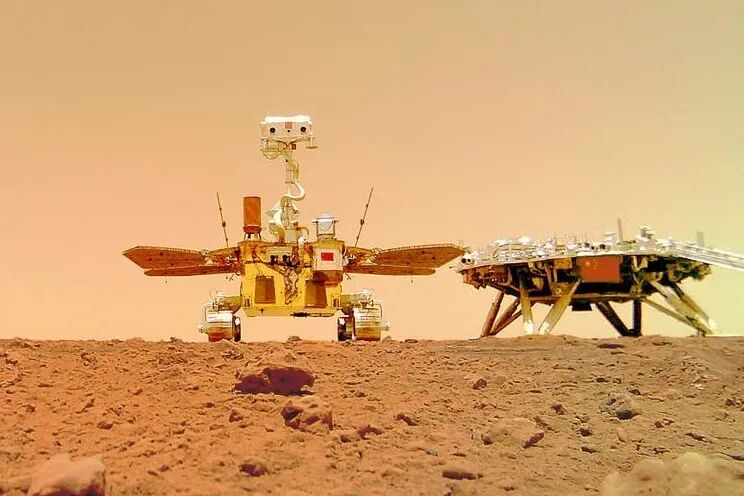
The landing craft of Tianwen 1 touched down on the Martian surface in May 2021 and then released a rover, Zhurong, to perform scientific tasks. The Chinese rover traveled about 2,000 meters on the Red Planet and transmitted a great deal of data back to Earth.
Reporter: Zhao Lei
本文来自公众微信号:CHINADAILY
|
|

 /1
/1 


 鄂公网安备42010202000179号 )